


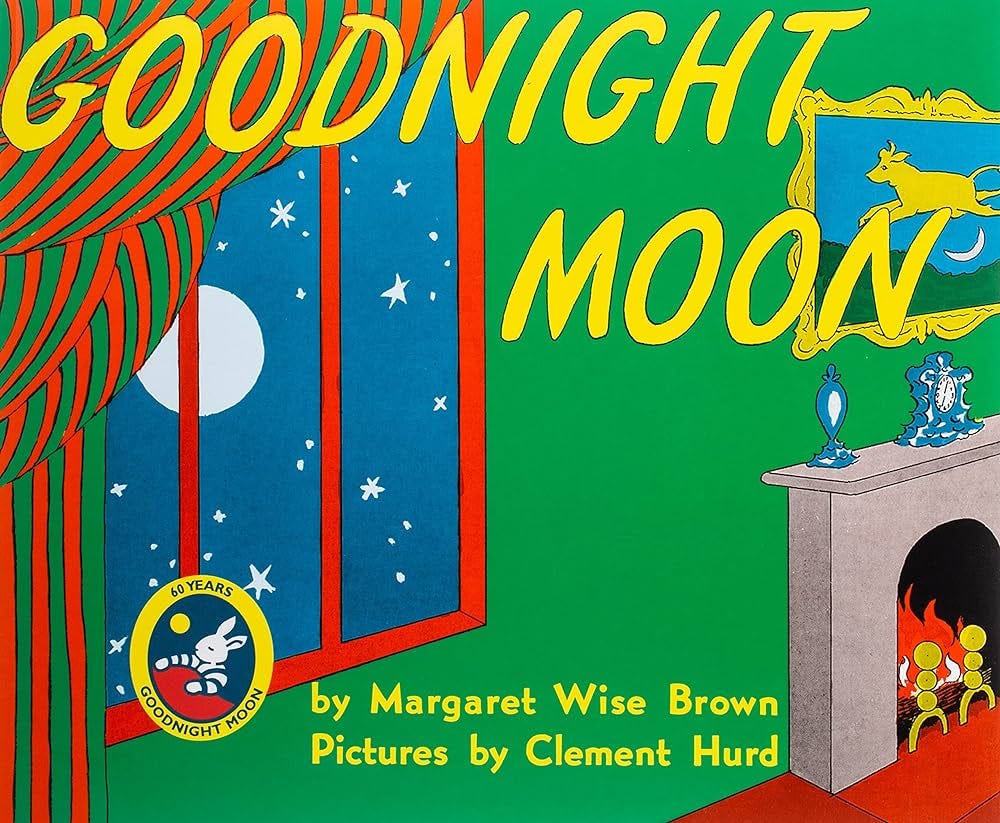
We have a bit of an aberration today in our regularly scheduled design-design-design! programming. But it this will all start to make sense, I promise.
And, please, if you like Schmatta, think about upgrading to a paid membership. I put a lot of time and thought into this content and I’m a real human trying to make the whole Substack thing work. Also: If you decide to become a founding member, I will help you design a room and/or create a personalized shopping list if you are in the market for a couch, table, whatever!
Margaret Wise Brown. You know her books. Goodnight Moon. Runaway Bunny. The more I read these books to my 4-year-old, the more I feel like I’m losing my grip on reality.
Because contained within a series of four books — The Runaway Bunny (1942), Goodnight Moon (1947), My World (1949), and Good Day, Good Night (published posthumously in 2017) — are overlapping multiverses and patterns that make you seriously consider the viability of the Simulation Hypothesis.
But only if you look very, very closely.
We must, of course, give credit to Brown’s illustrator, Clement Hurd, for his work in crafting the environments of the first three books; and Loren Long for picking up Hurd’s work in Good Day, Good Night.
The decor world has long adored the Goodnight Moon bedroom with its generous striped drapery, Rococo mantel clock, and curious animal skin rug. But something sinister is lurking in this room. It should be a warning to us all.
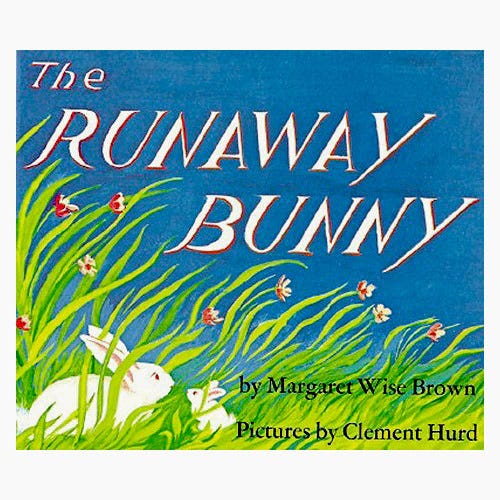
Let’s start with the first book, The Runaway Bunny. First off, Runaway Bunny (henceforth referred to as RB) is a terrible child. All he wants is to get away from his mother bunny (MB), who is always one step ahead of RB. It’s 1942. It’s, uh, a weird time, to say the least. Americans are shipping off their sons to fight a deadly war in Europe.
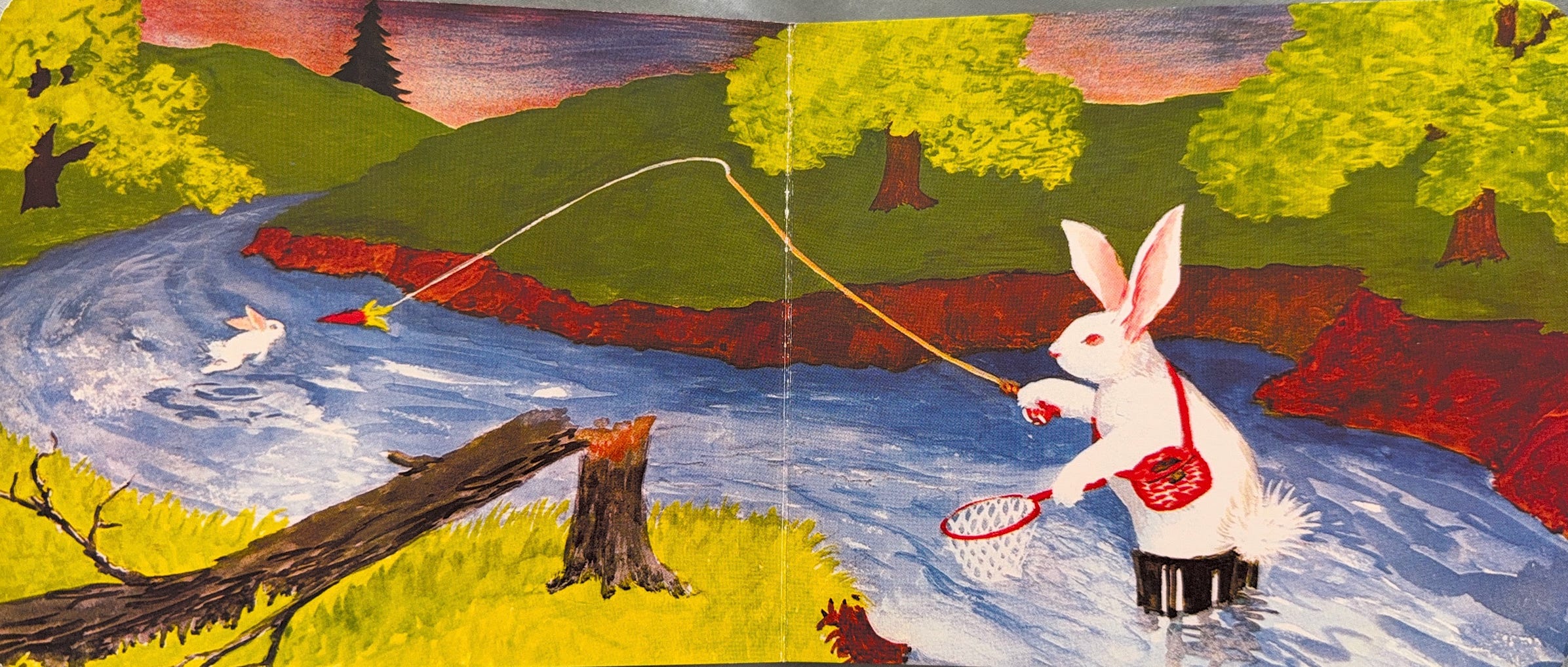
First thing to pay attention to in The Runaway Bunny is the full-color image of MB baiting RB with a carrot in a stream. Remember this. It will become very important.
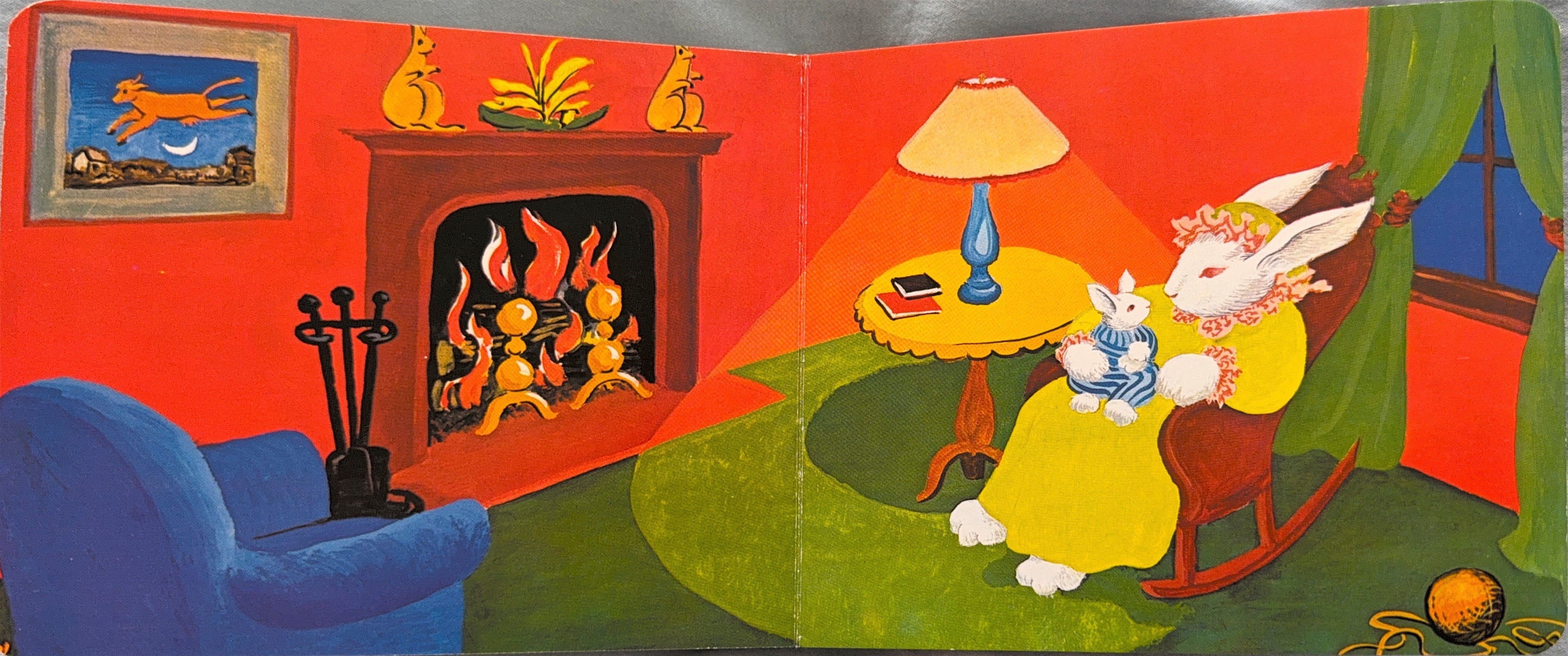
Second important spread in The Runaway Bunny is this fireside scene close to the end. Note that RB is now wearing blue striped pajamas, akin to Goodnight Moon. And I don’t know what we do with this information…but remember it’s 1942. Blue-and-white stripes are being used elsewhere across the Atlantic in the most diabolical of circumstances. But let’s look closer at this tableau. The furniture is similar to that of the nursery in Goodnight Moon, but more importantly, there is a full-color painting of a “cow jumping over the moon”:
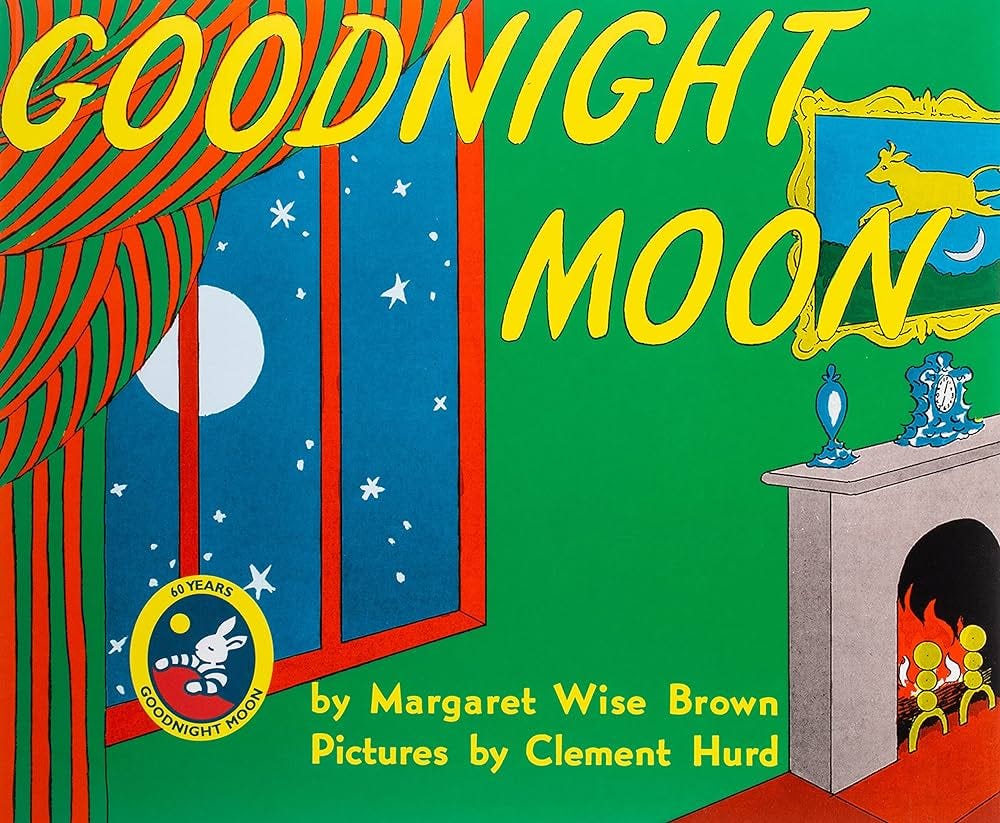
Let’s now thumb over to Goodnight Moon. And I’d like to point out that the curtains on the cover are orange and red NOT yellow and green. What kind of trickery is this? Anyhow…
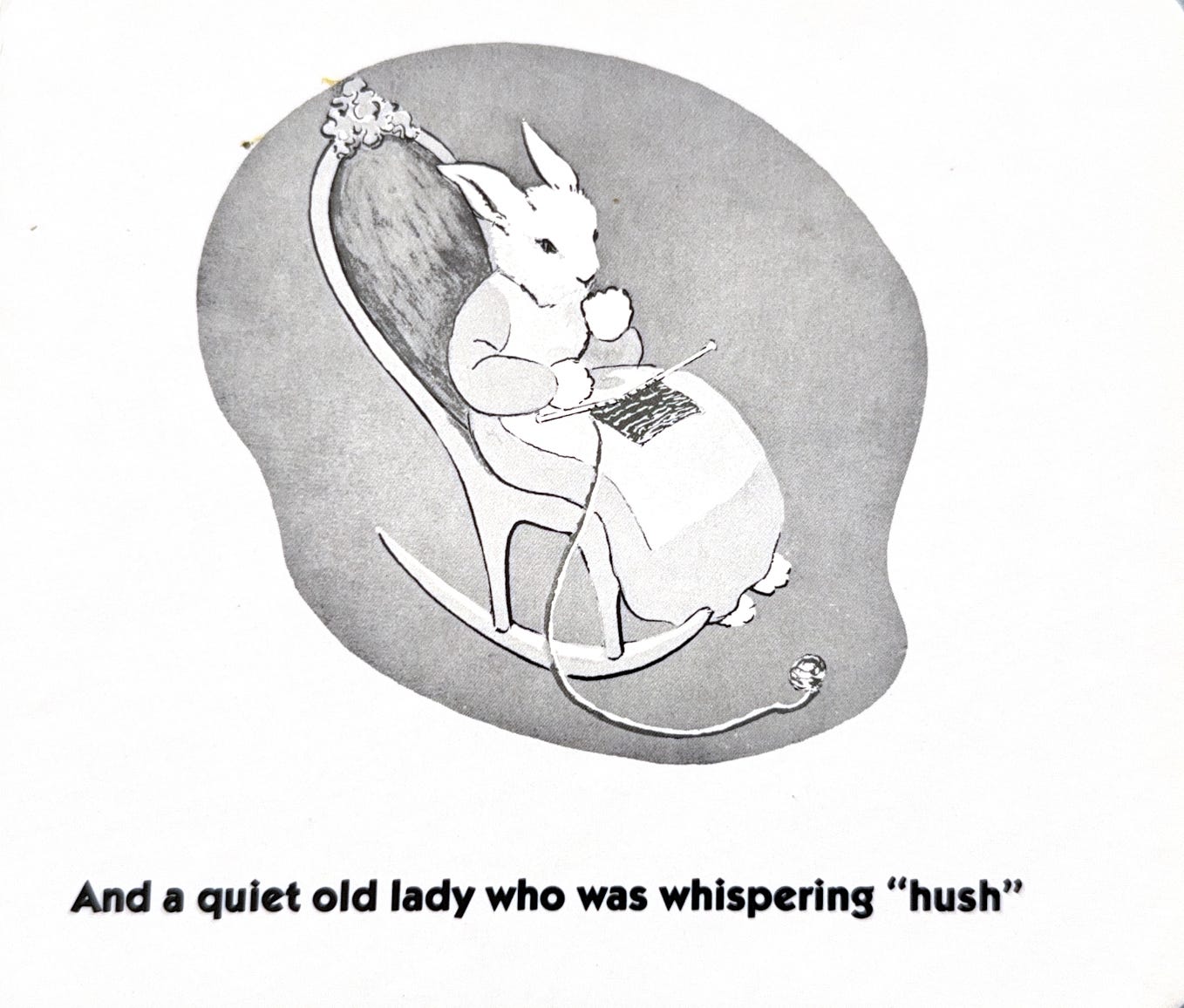
The first overlap we can detect is that RB and MB are now recurring characters, although in Goodnight Moon, there is no established familial relationship. MB is just an “old lady” (rude).
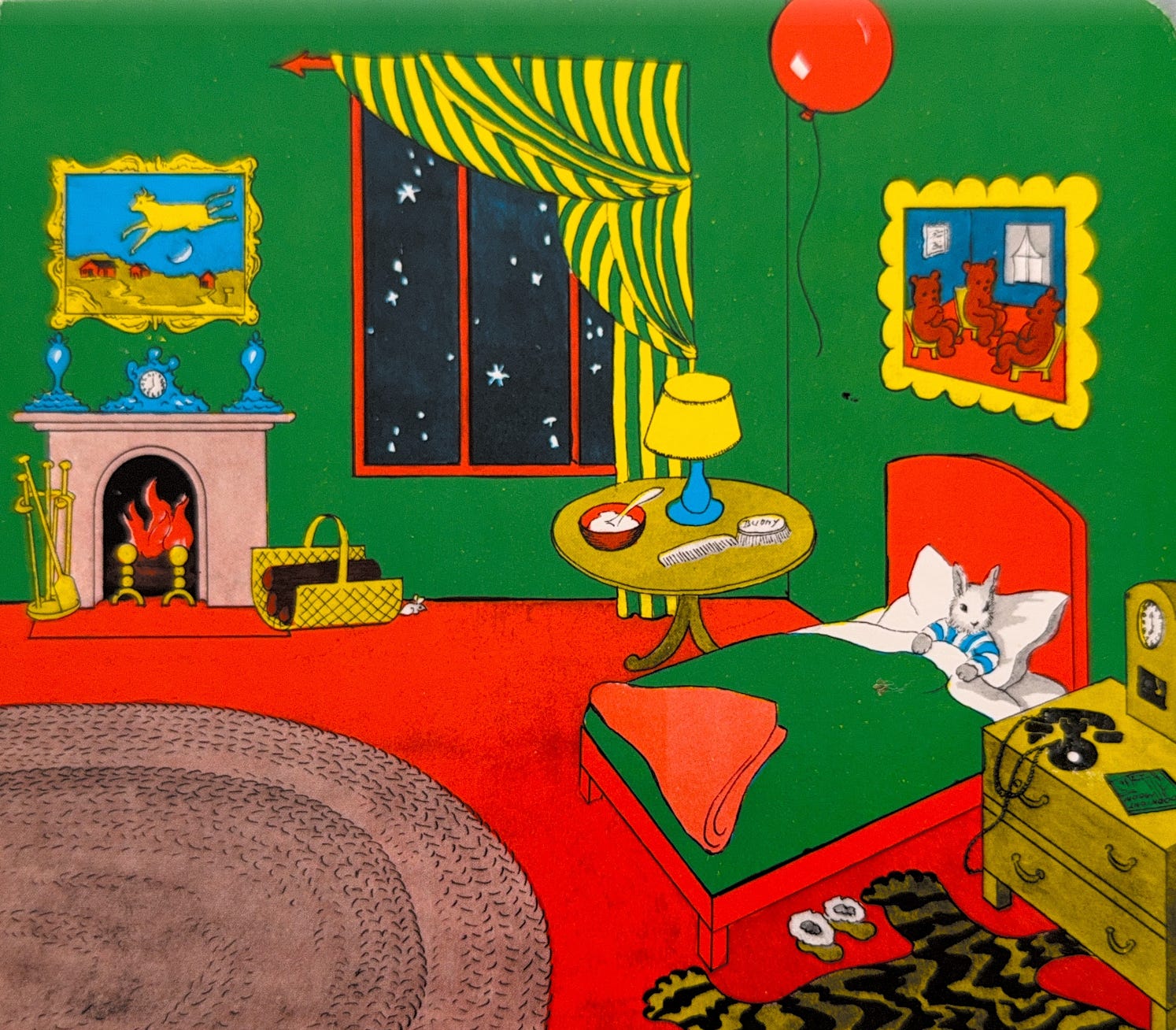
We are immediately re-introduced to the cow-jumping-over-the-moon painting.
We’re also going to take a look at the clock on the mantel — the time is going to advance as the book goes on. When we start the book, it’s 7 p.m.
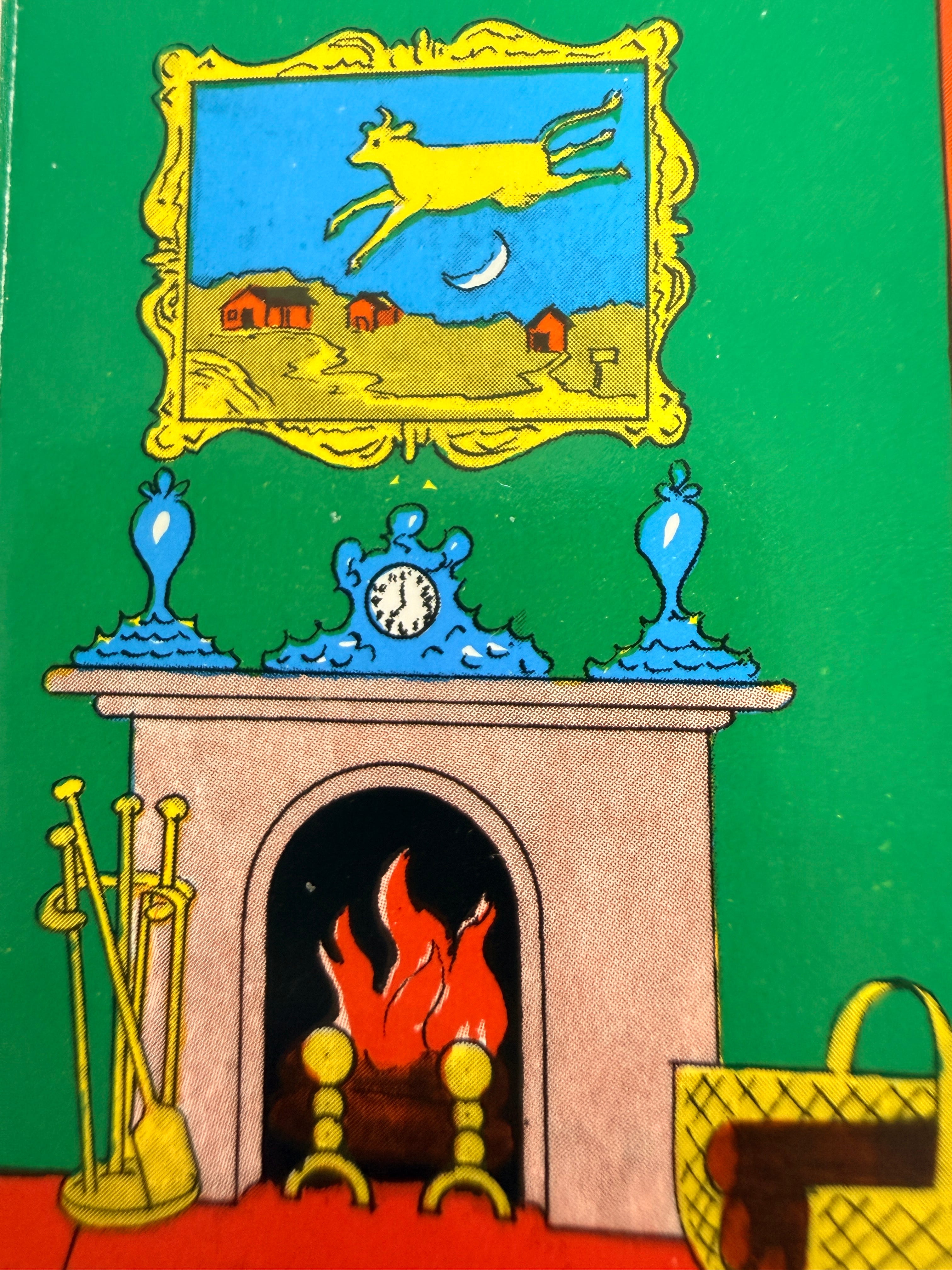
And we finish at nearly 8 p.m.
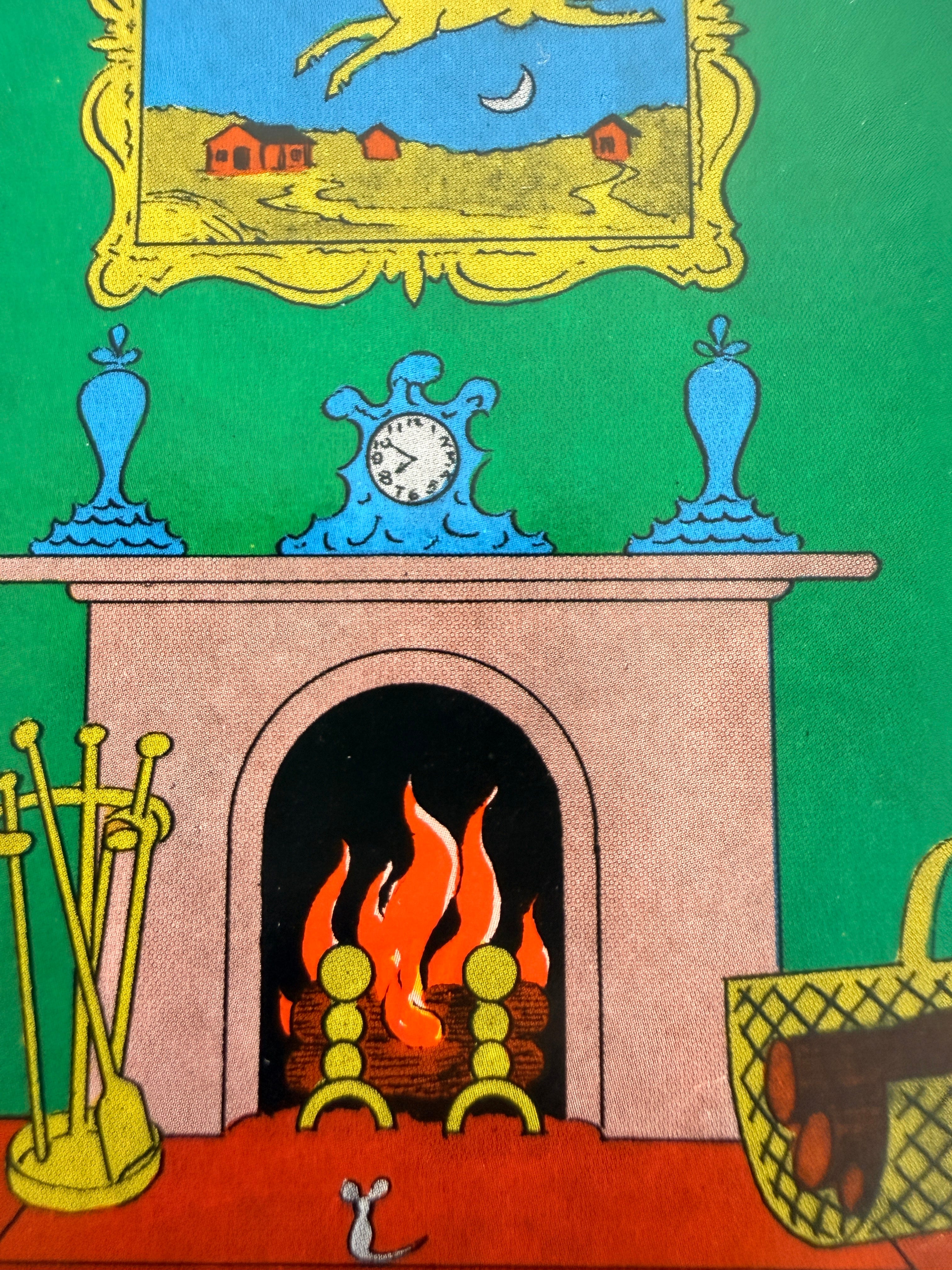
Also, I’m sure, if you have read this book billions of times like I have, you’ll notice that the little mouse moves around the room in every illustration. Plotting something, clearly.
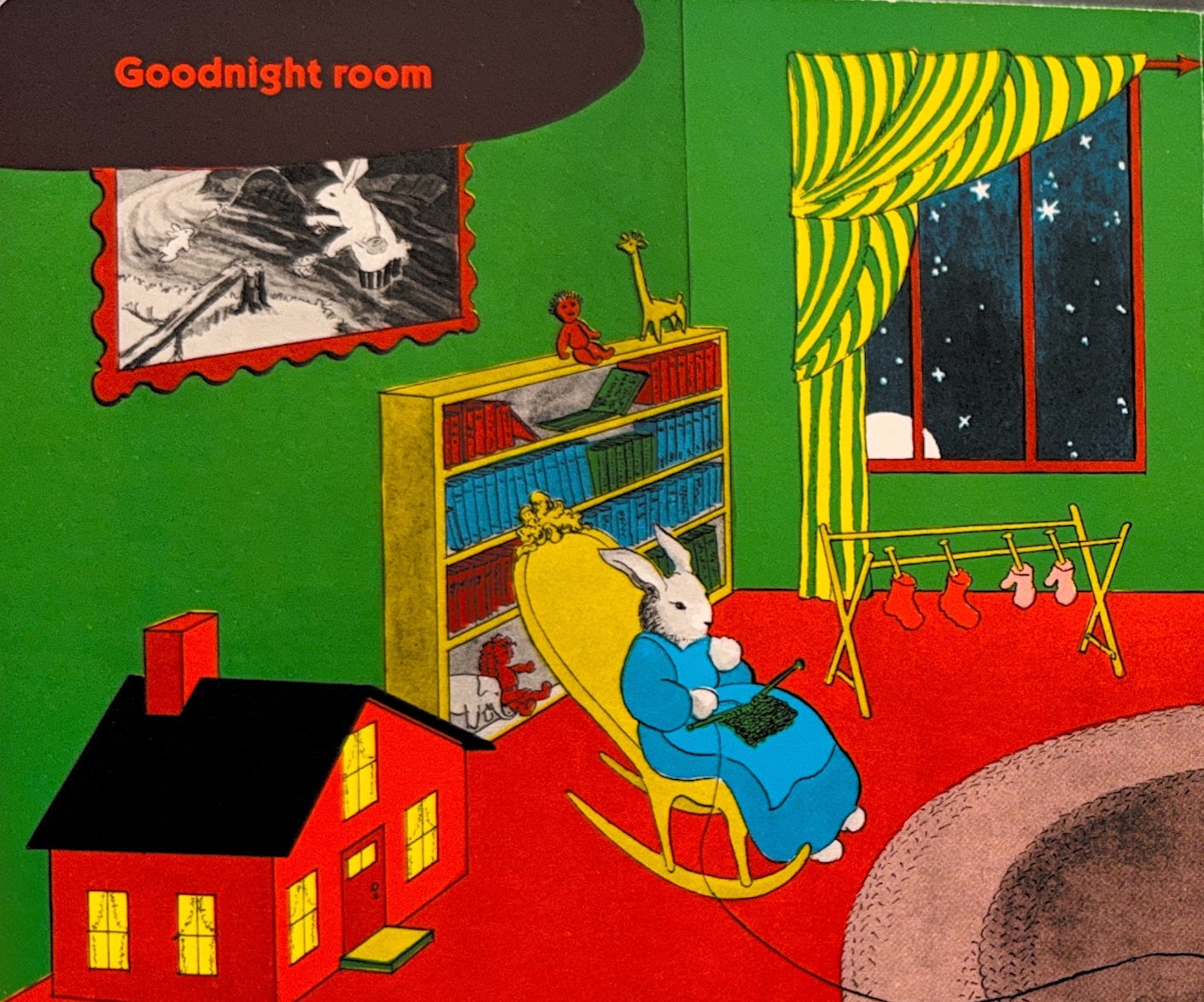
Now let’s inspect that three little bears painting. Because within that painting, on the wall, is a duplicate of the cow-jumping-over-the-moon painting.
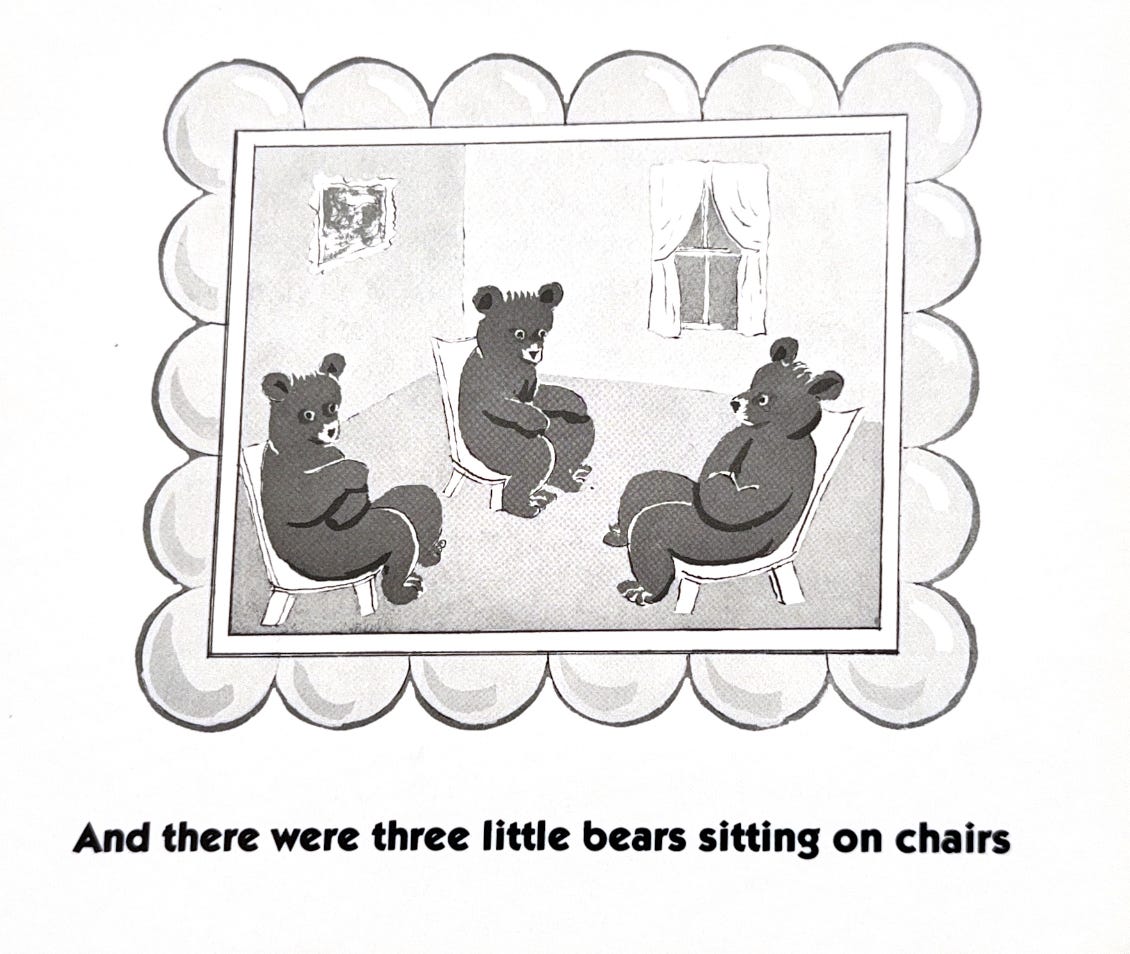
This is the point at which the sign has become untethered from reality. The cow-jumping-over-the-moon image is no longer depicting an event. It is depicting a depiction of an event. At this point, Baudrillard is having a field day.
Now, the dollhouse.
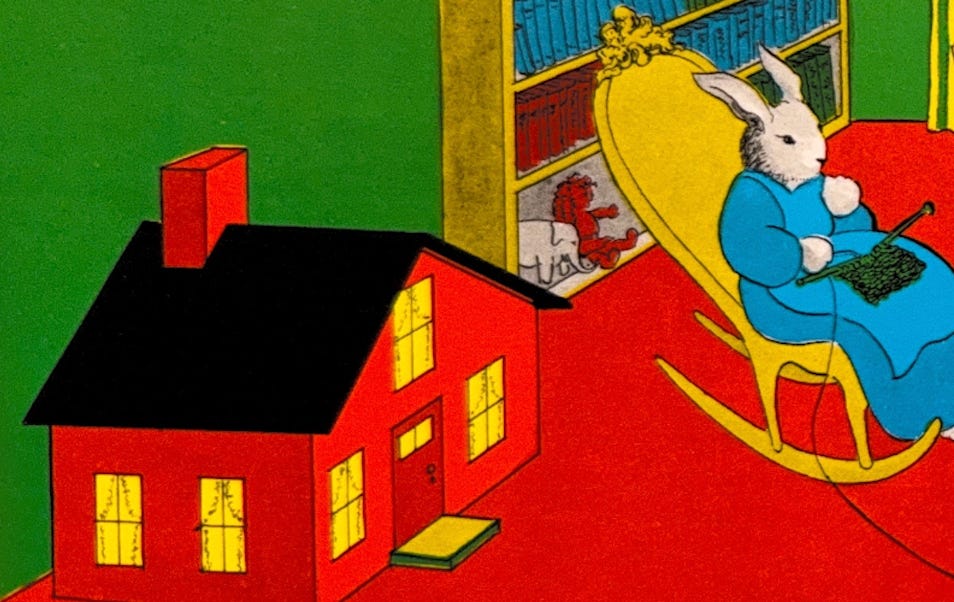
Which is clearly…where the three little bears live, because aren’t those the same curtains?? This is all becoming very “THE CALL IS COMING FROM INSIDE THE HOUSE!”
This can be referred to as a “recursive sign system.” I refer to it as a dollhouse operating a shadow government.
But we also need to examine the bookshelf, because on it, in very teeny tiny writing, on one of the books, we can make out the title, The Runaway Bunny.
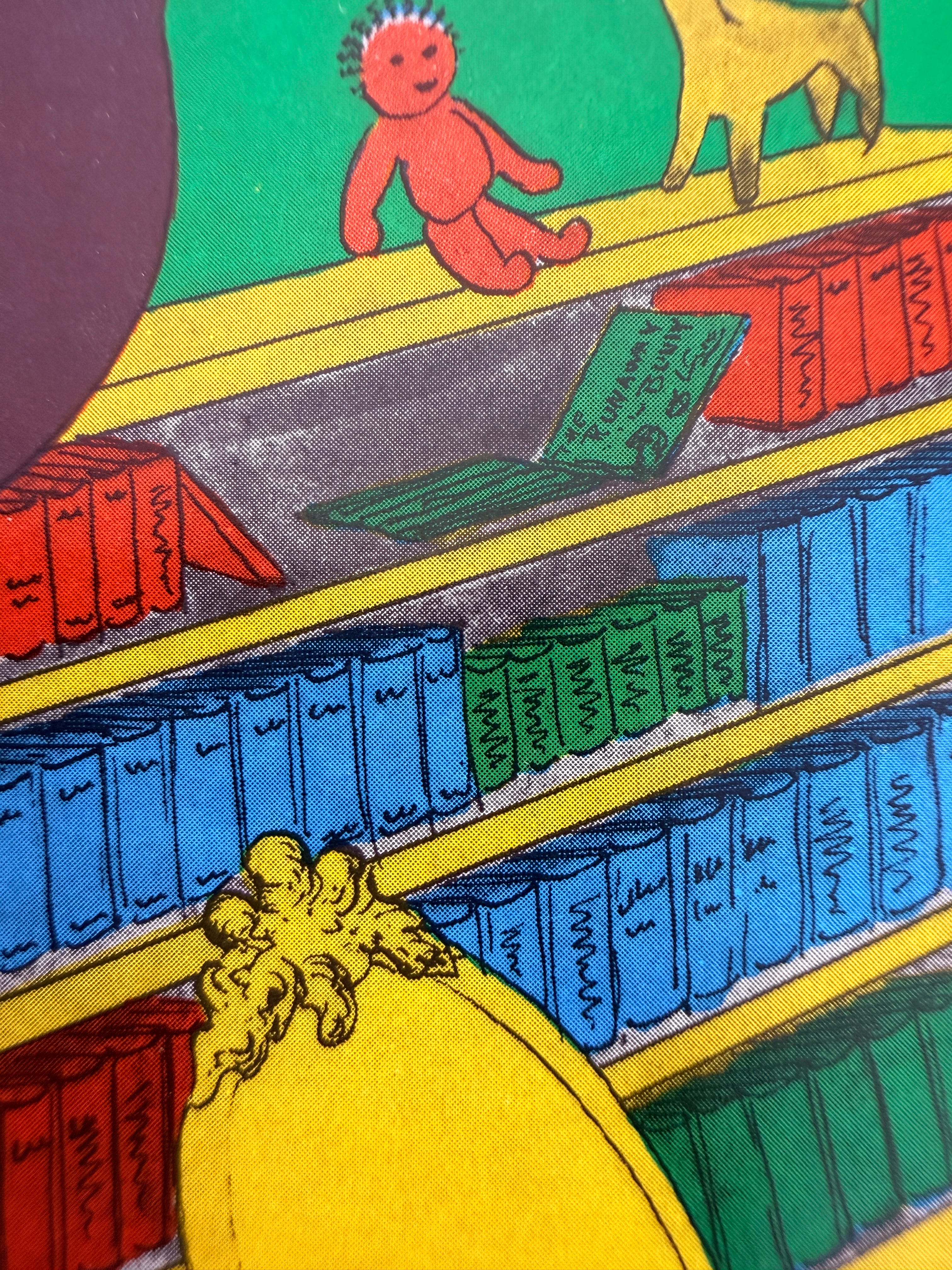
It’s fully weird at this point because now we have to consider the possibility that The Runaway Bunny ceases to be a story and becomes an artifact within its own universe.
And when we zoom out further, above the bookcase is a black-and-white painting of MB trying to bait RB in the stream.
Okay. But the true, rule-bending mindfuck comes when we can more clearly discern what is on the little bunny’s nightstand. It’s A COPY. OF. GOODNIGHT. MOON.
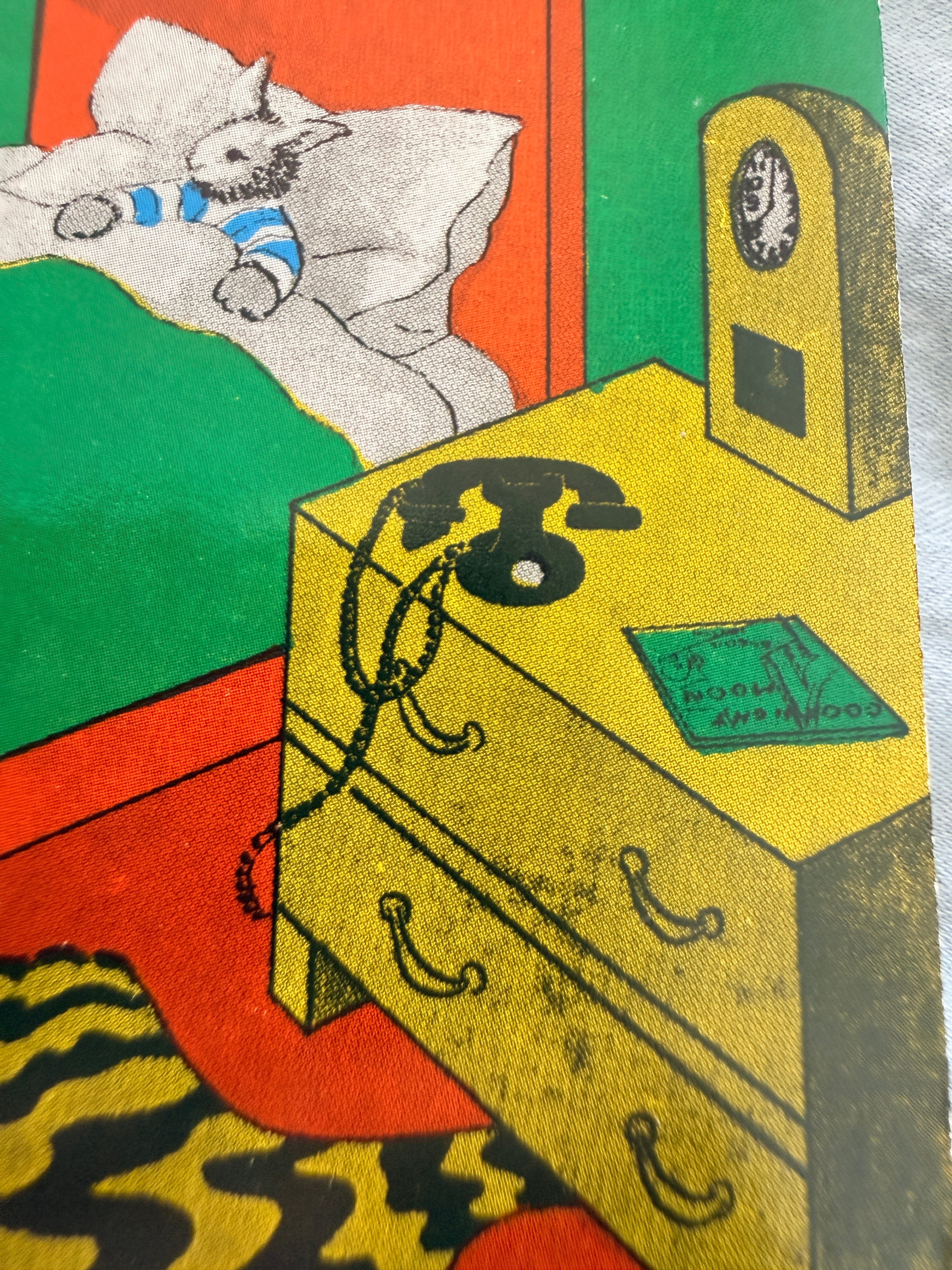
This is now full-on psychological warfare!!! We’ve been Black Mirrored. If the bunny in Goodnight Moon is reading Goodnight Moon, is there another bunny inside that copy reading another copy of Goodnight Moon? It’s a hall of infinite mirrors.
After some ujjayi breathing to calm us down, we can continue on to My World.
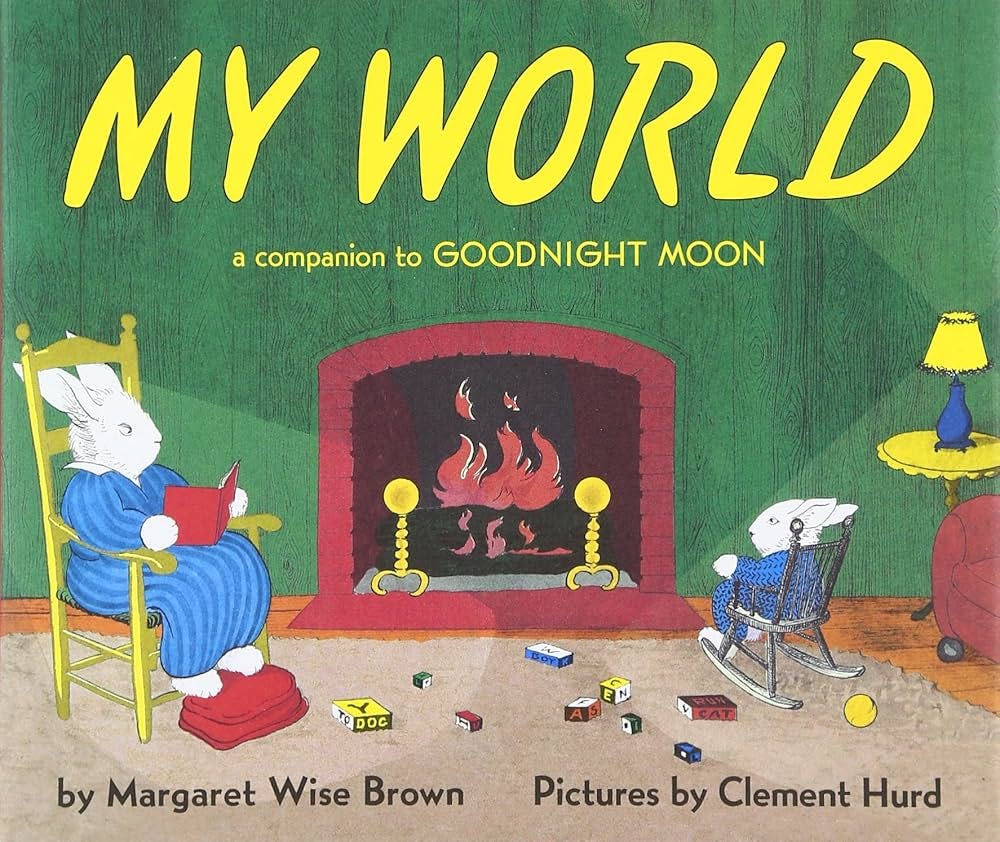
It’s 1949 and the war is over, thank Jesus. And all of a sudden MB and RB have a father figure in the picture — perhaps he’s returned unscathed (physically, yet not emotionally amirite?) from the war?
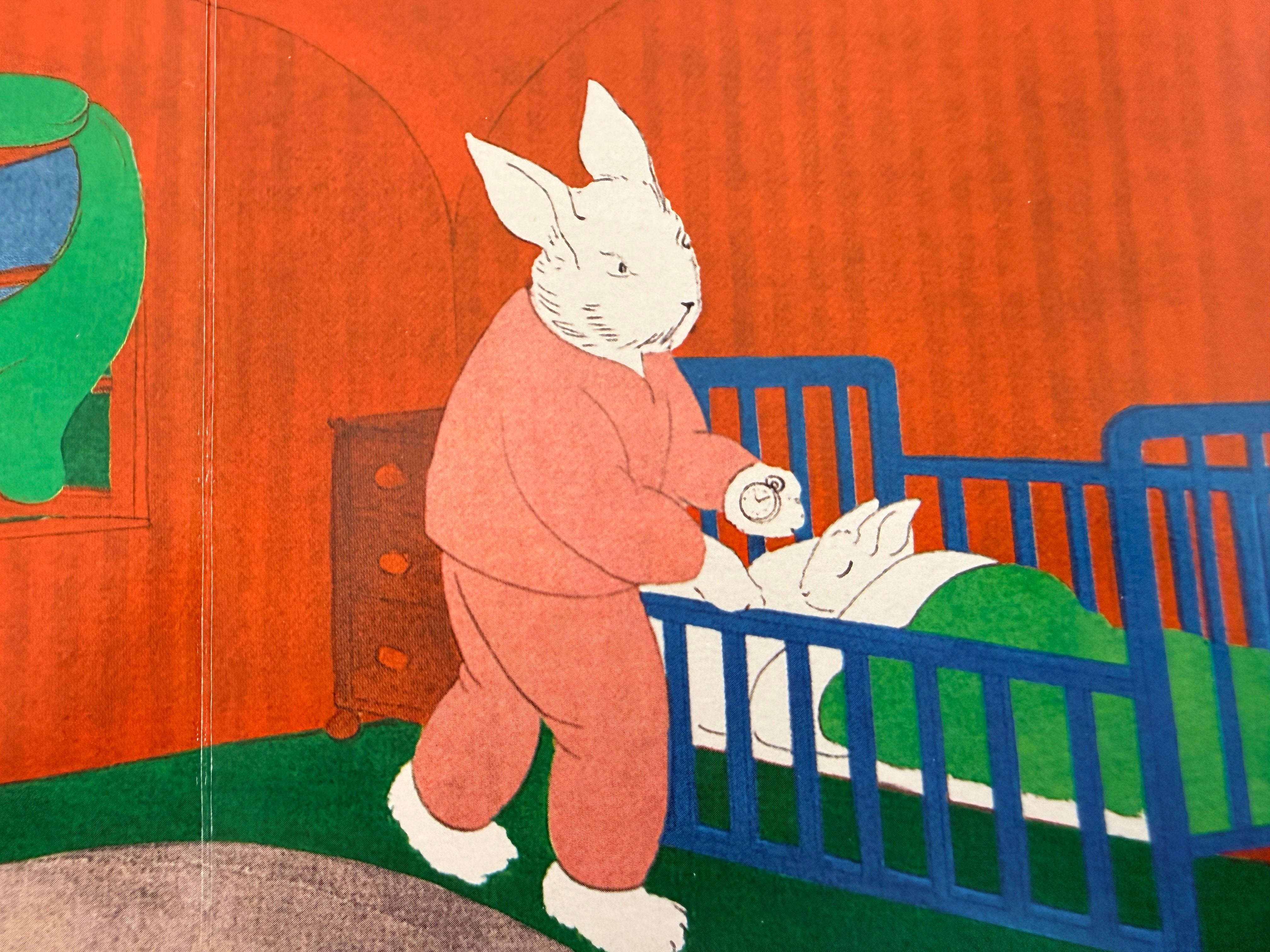
For the most part we have some super nuclear family stuff going on in this volume. MB, previously a badass mountaineer/shapeshifter/tightrope walker/the fucking “wind” as portrayed in The Runaway Bunny…

Is now relegated to the realm of women’s domestic work, multitasking between making breakfast, feeding multiple animals, and presumably moderating the behavior of both her son and husband.
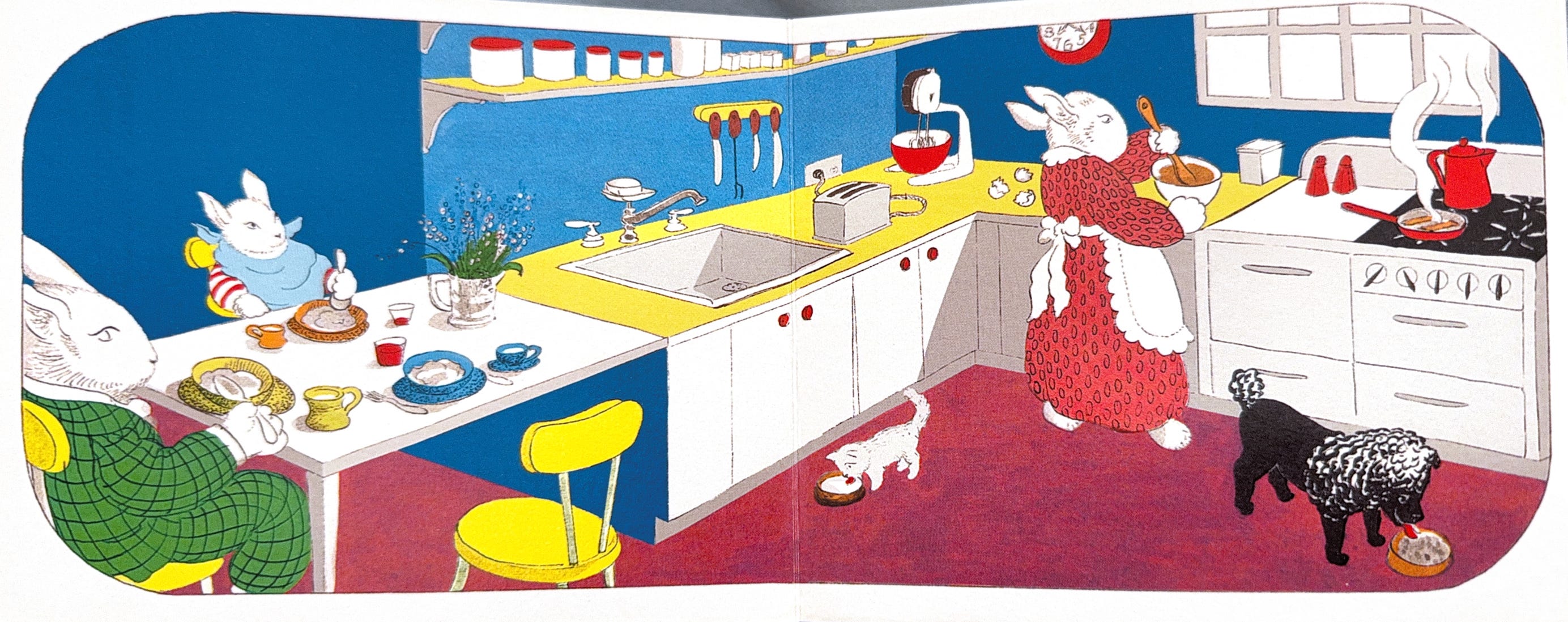
Everything’s going pretty well until bam bam bam!! What the fuck is that?? It’s dinner with the in-laws and in that dining room is…a framed image of MB wrangling her motherfucking son in that G-D river that she did seven years earlier.
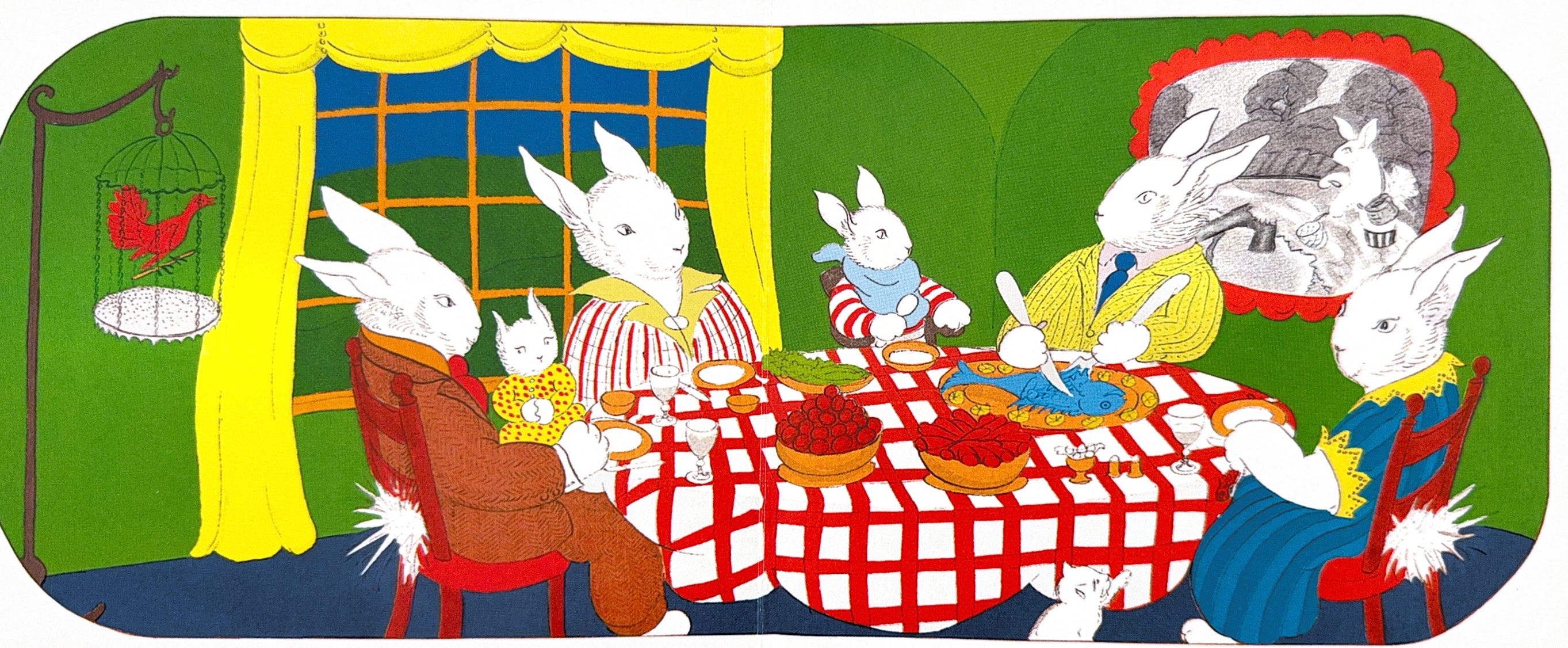
Are we beginning to suspect that this image is MB’s silent rebellion? An attempt to remind the patriarchy: DO YOU NOT SEE WHAT I HAVE BEEN THROUGH?
We will never escape this image. It simply persists.
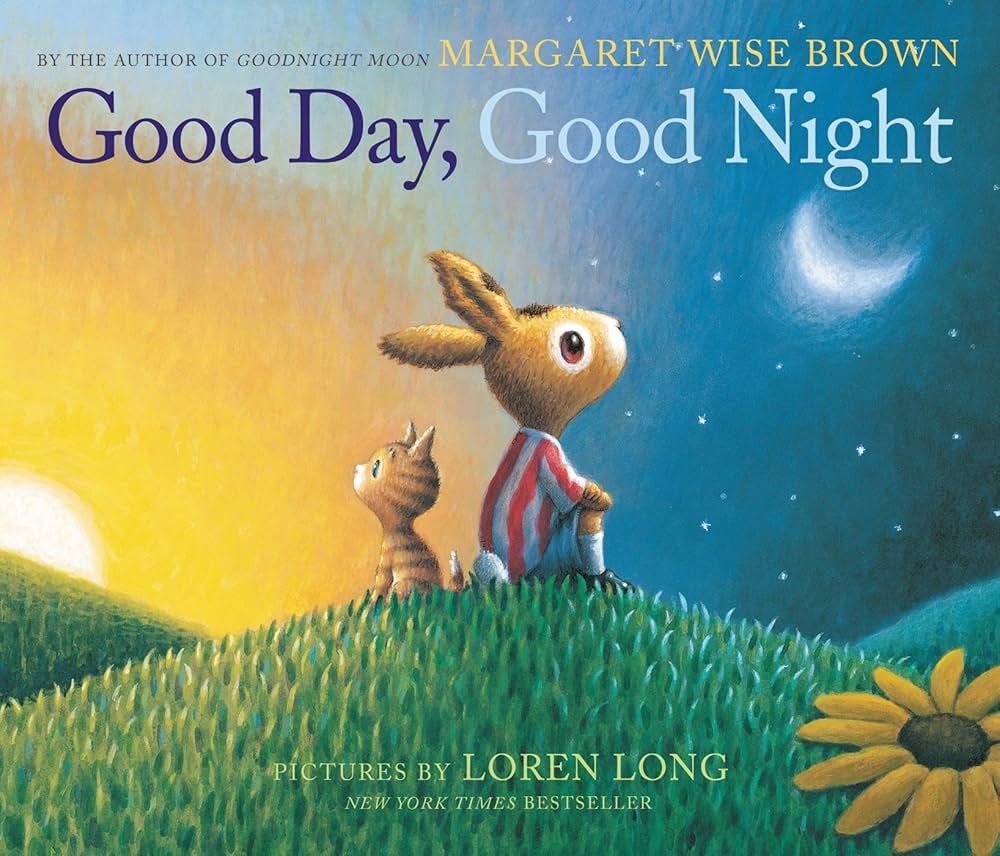
We can all finally recover from our collective heart attacks in Good Day, Good Night, where things at least feel like a more quiet, logical progression.
The bakery — or the Bunbunnyrie — takes inspiration from Goodnight Moon’s green-and-gold curtains.
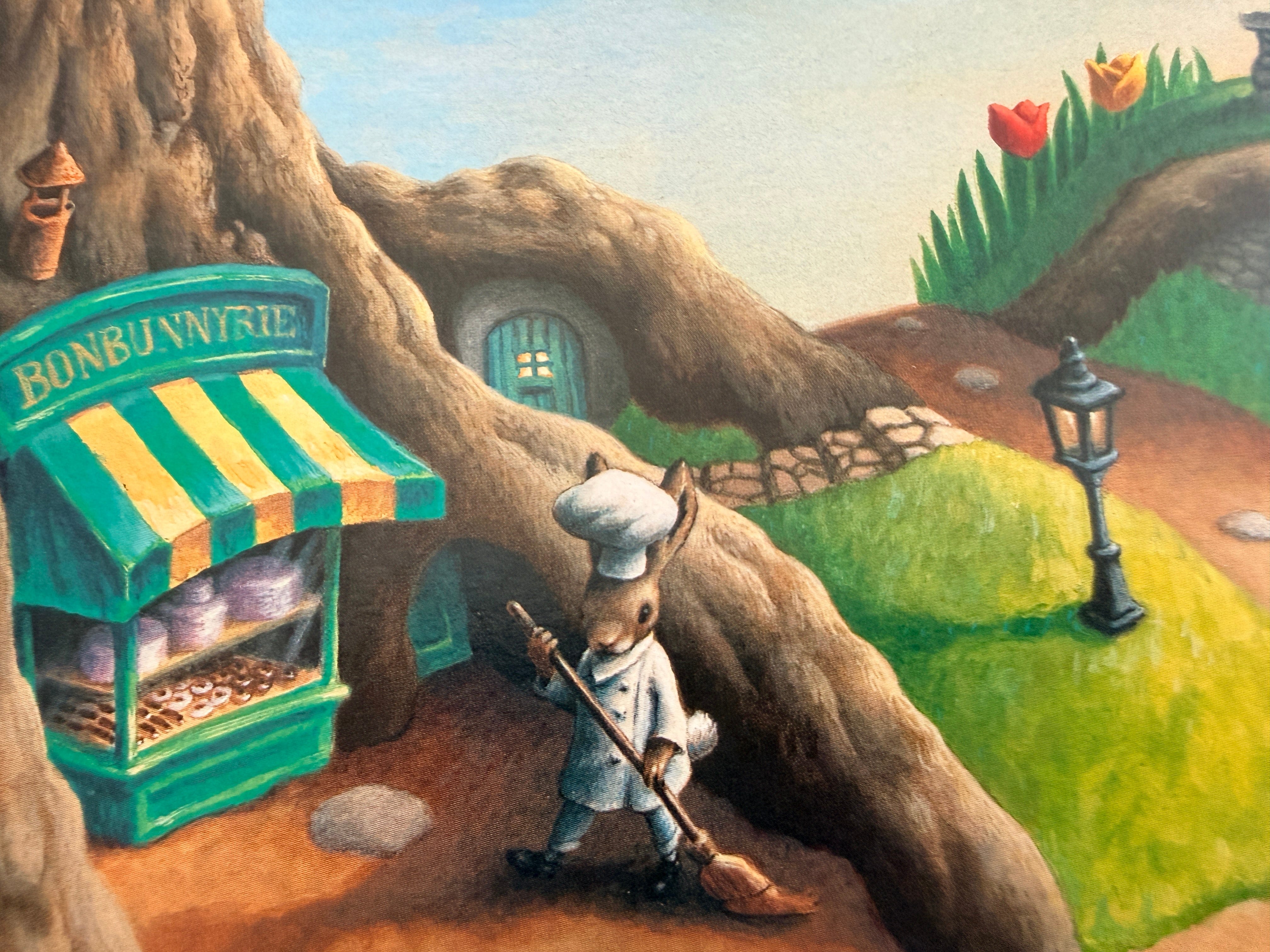
As does the bunny’s bedding:
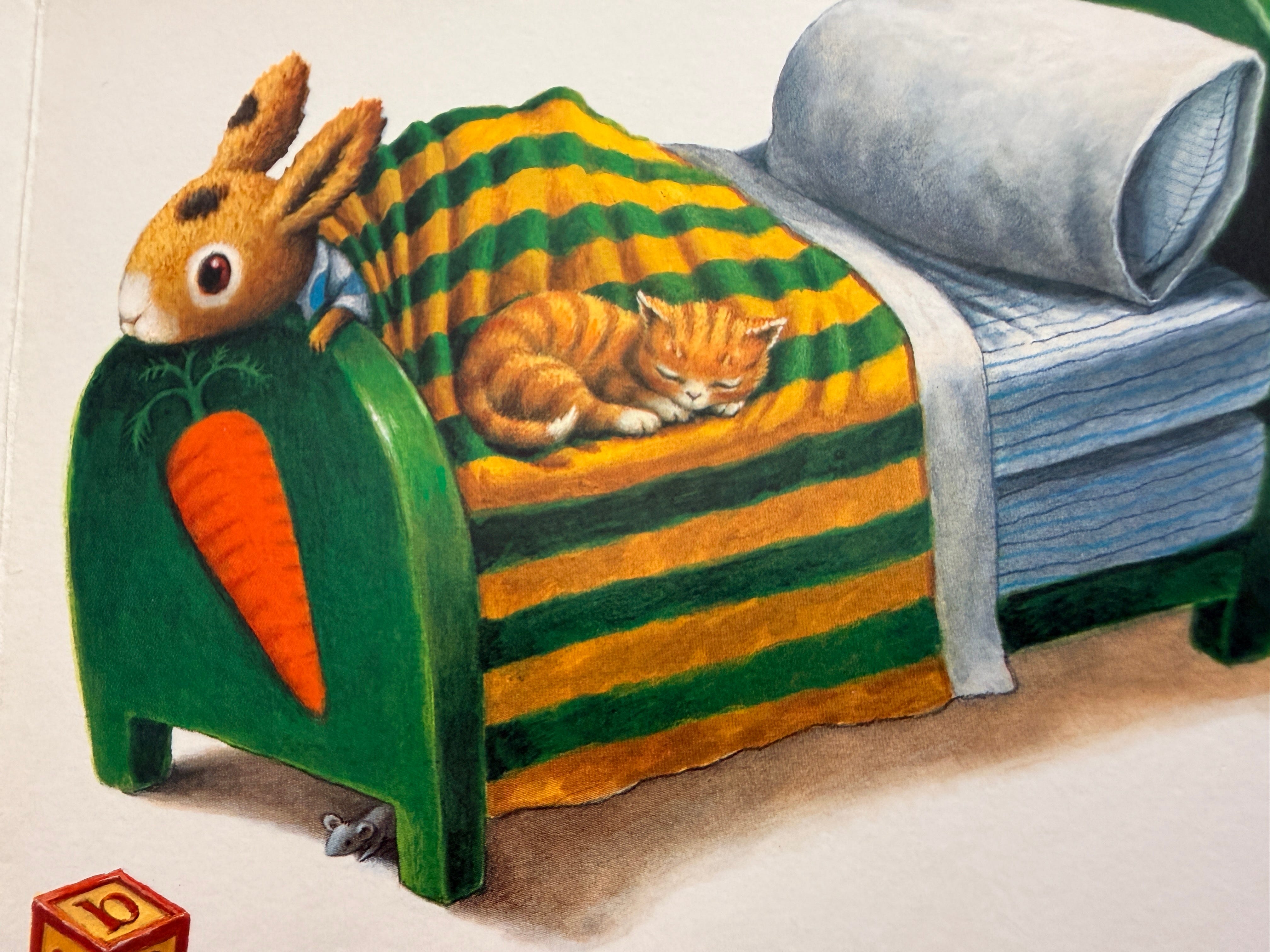
Thankfully, there are no ominous paintings following us around. Just these “cow jumping over the moon” bookends.
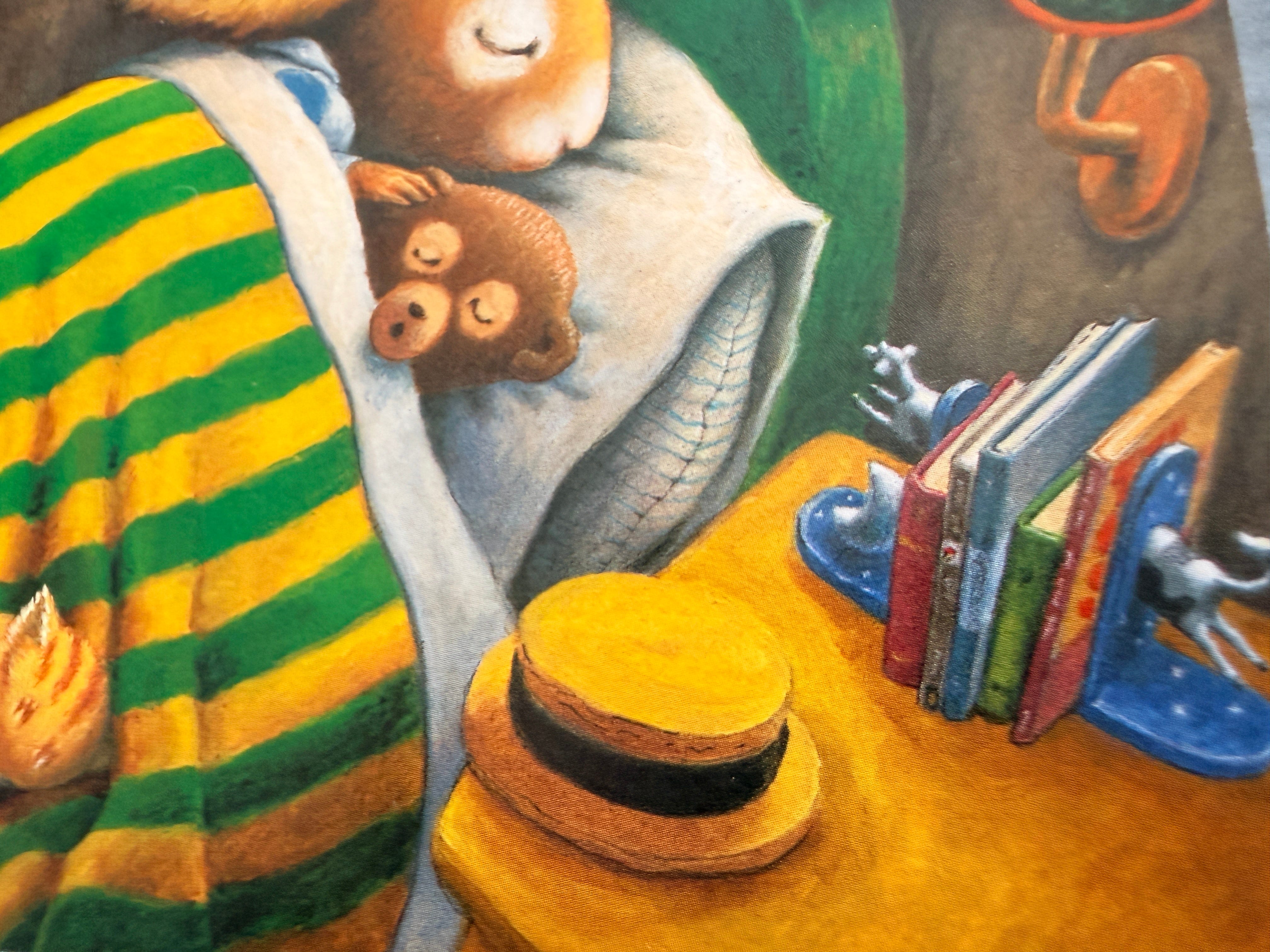
Thank the lord.
Now, Goodnight, Substack people.
Goodnight, Hamish McKenzie.
And Goodnight, Chris Best.
Goodnight restacks everywhere.
RELATED:
'Each Peach Pear Plum' Was the OG Cottagecore Handbook

2020-2021 was a terrible year for culture, thanks largely to TikTok which imposed upon us a spate of fleeting, nonsensical trends: goblincore (?), dark academia (??), coastal grandma. But one trend emerged with at least some staying power: cottagecore, the aesthetic defined by prairie dresses, gingham motifs, “antiques,” anti-minimalism, and people acti…
The kind of hard-hitting journalism the world needs right now. We're all living in the bunny-verse.
Have you read Rumaan Alam's piece on the best rooms in children's literature? An oldie but a goodie. https://slate.com/culture/2016/08/from-goodnight-moon-to-richard-scarry-the-great-rooms-of-children-s-literature-reviewed.html