
Why Historic Homes Suck Us In
Will generations to come feel the same reverence in new-build high rises? Probably not.
Today, we’re talking with my friend Robert Khederian about our love for old houses. Robert’s the author of one of my top three favorite Substacks, Second Story, which covers historic NYC real estate and antiques, among other things. He and I share an obsession with history and “old fashioned-ness.” In the comments, we’d love to hear about your own old home stories.
Leonora Epstein: So, Robert tell me: Where’d you grow up? What kind of house did you grow up in?
Robert Khederian: I grew up outside of Boston decidedly not in an old house. It was a Georgian colonial built around 1990! It did have some of the hallmarks of older houses like carved woodwork, but I guess it didn’t matter, because I grew up to be one of those kids obsessed with the Titanic.
Leonora: Obviously, same. But continue.
Robert: I wasn’t interested in the history or the details of what happened—I loved the interiors and the furnishings and the glamor of the ship! What about you?
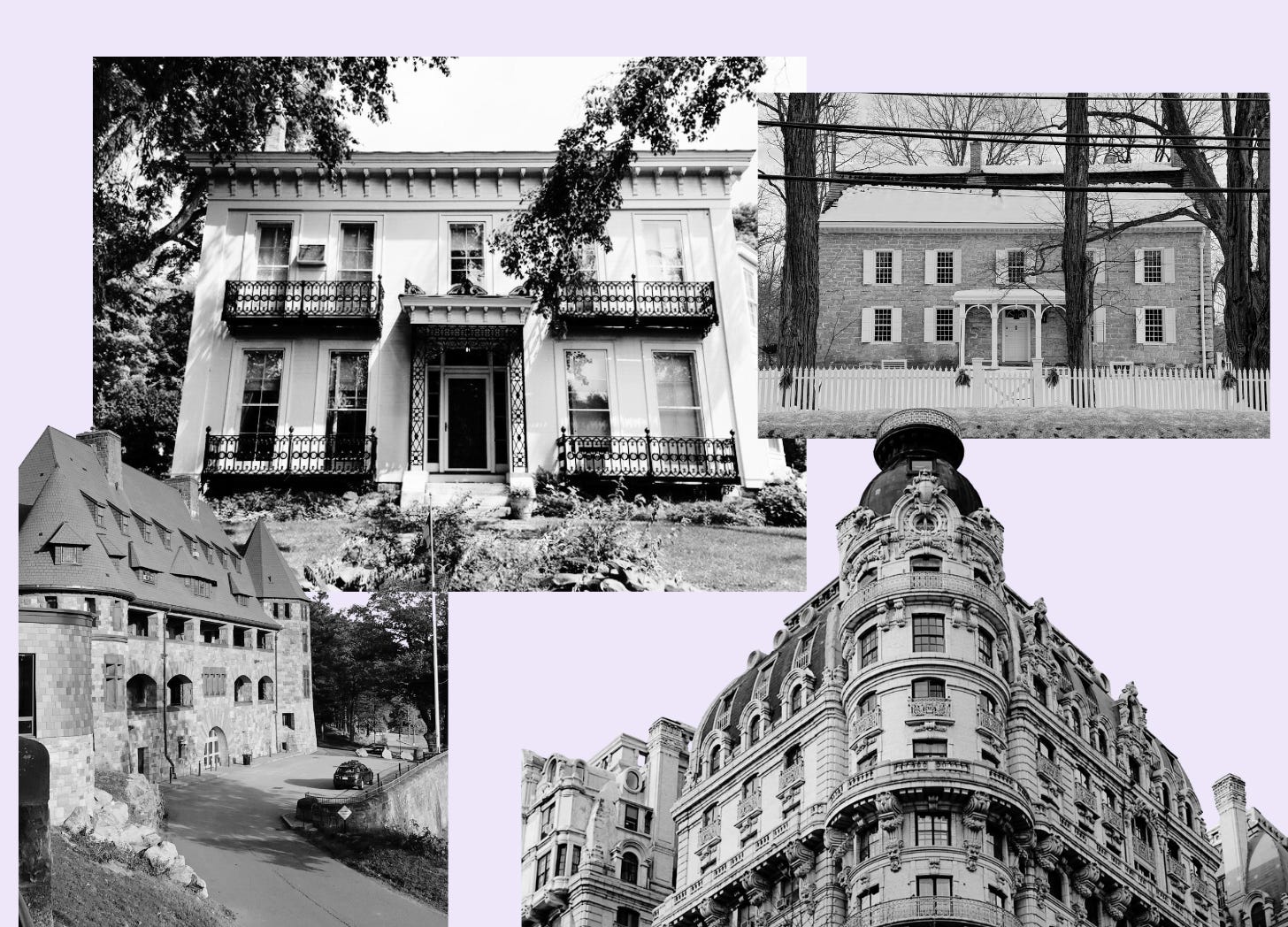
Leonora: I was born in New York City, and lived on the Upper West Side until I was eight. Then, my parents bought this run-down Italianate Federal home (built 1832) in North Adams, MA and all of a sudden, we were living in a B&B. They called it Blackinton Manor, named for the businessman who defined the area.
As they say in design media home tours, “the bones were there”—wrought iron balconies, a winding staircase, floor-to-ceiling pocket windows. But it was a mess with a very 1970s living room.
BTW, the house is now being taken over by the people behind Tourists. Once they open, I have a feeling I’m going to see a lot of people on my IG feed posting pics from my old bedroom.
Robert: So did this house start your love of historic homes?
Leonora: I think so. But my mom was always the type who, when we went on vacation, the historic home tour was mandatory. So it became ingrained in me. I was an odd child obsessed with “old-fashionedness”: American Girl dolls, Anne of Green Gables, Victoria magazine. All this culture that really felt archaic and distant from ours. But nowadays we have so much access to history; I feel like that distance will never exist again. Nothing will feel old-fashioned again.
I’m curious if you have certain old or historic buildings or homes that have really stayed with you?
Robert: Yes, and strangely enough, they’ve all been places where I went to school. When I was in fifth grade, I went to an all boys school called Fessenden, and then I switched to a co-ed school called Noble and Greenough. Both campuses were at one point private estates, and the original houses are still on the properties. I was fully obsessed with both houses—I distinctly remember asking the headmaster of Fessenden about the history of the house (it was Colonial Revival) and wanting to see old photos of it.
At Nobles, we had “The Castle,” which sounds ridiculous but it quite literally is a castle. It was designed in the late 19th century by H.H. Richardson, and has turrets, a fortified entrance, and stunning woodwork and carved fireplaces.

The place where I took piano lessons in Cambridge also happened to be a Richardsonian Romanesque house, although it wasn’t designed by H.H. Richardson, just in his style. I would just delight in walking around all of those houses. They’re not really styles that I seek out now, like, I really love Greek revival and Federal now, but those three houses really let me indulge my geeky interest and develop a more personal relationship with historic architecture.
And then there’s the Wynkoop House now in Stone Ridge!
Leonora: What’s that?
Robert: So, about a decade ago, I was wistfully searching Zillow for interesting houses for sale, and I saw these stone houses for sale in Stone Ridge near Kingston. My partner John and I hadn’t ever been there before, so we went up for a weekend and we drove around looking at houses.
Right on Main Street is this very impressive large stone house with a gambrel roof, and that’s the Wynkoop House. It’s known as one of the most beautiful, impressively intact stone houses of that type in all of New York State. I posted a picture of it on Instagram, and coincidentally, the owner’s husband follows me, so he arranged a tour of the house, and then a few months later my partner John and I rented it with a few friends, and we’ve been returning every year on President’s Day weekend for the past decade.
That house has really kept a fire burning, literally and figuratively—there are so many fireplaces in that house—for old houses. When I first saw it, I remember thinking that was exactly what I wanted my future country home to be like. Wynkoop is probably the one house that in my adult life, besides, like, the house that John and I own, that has made the most impact on me.
Leonora: Important buildings for me…obviously Blackinton Manor. Even though I was a pissy city kid who claimed to hate living in “the country,” it was the most adventurous moment of my childhood and I look back on it with a lot of love.
I moved back to NYC at 14 for high school and lived in this triangle of three epic buildings: the Ansonia (1904), the Apthorp (1908), and the Dakota (1884). The Dakota in particular holds a lot of mystery for me and I love reading about its history. And the Apthorp, the details are just so delicious. When I walk by now, and look up, and you can see that an apartment’s mouldings have been removed and there’s some weird contemporary light fixture, I’m like NOOOOO! You don’t gut an Apthorp apartment. You just don’t!
Then, I went to Smith College in Northampton, MA and I kind of made the decision based on the esthetics because I wasn’t particularly interested in going to an all-women’s college. It’s so quintessentially New England and has this sense of history, you know, black and white photos of women in long skirts playing basketball, a Life magazine spread of girls in sweater sets, Sylvia Plath. There was just something very nostalgic about it. The pathways at the heart of the campus were created by Frederick Law Olmstead, who designed Central Park. I’m dying to go back to see the library’s renovation, which was done by architect Maya Lin.
Robert: The Ansonia has some really beautiful details. The window hardware in that place is quite stunning. As for the Dakota, I don’t know if this is true or false, but what I’ve heard numerous times is that they require you to save the woodwork. So if you elect to take it out of your apartment, you have to save it in case the next person wants to reinstate it.
Leonora: Okay, so the last thing I wanted to ask you about is your Upstate New York home, which seems very old to me.

Robert: It’s a little over 200 years old! It’s way upstate in the Finger Lakes, and it’s part Federal, part Greek revival, which are my two favorite architectural styles. I never thought we’d wind up with a house that mashes them together, but that’s what you get over a few centuries, I guess! We just came out of a long process of restoring rooms after a flood last April (check your toilet supply lines, people!) but I’d be lying if I said I don’t dream about a full-scale kitchen remodel. Maybe that can happen soon. You’re also in an older house, right?
Leonora: Yes, I guess you could say my home is “historic.” It’s a 1923 craftsman in a landmarked district called Bungalow Heaven (in Pasadena, CA). Plenty of the original details are intact, but sadly the previous owners did a very Home Depot renovation. The kitchen is now open concept with gray vinyl floors; anyone new who comes into my home, I’m just like, sorry for the floors, it wasn’t me! They also took out some built-ins (aargh!!! Why do people do that??) and created a ridiculously large bathroom for a house of its size. One day we’d like to do a thoughtful renovation of the kitchen and bathroom and try to salvage some craftsman cabinets to reinstall built-ins (hat tip to Pasadena Architectural Salvage!).
Got a cool historic home story? Let us know in the comments! Also, please subscribe to Robert’s Substack, Second Story!


