
The New Lighting "It-Girl" Is Anna Dawson
Dreamy pendants and sconces that make magic.

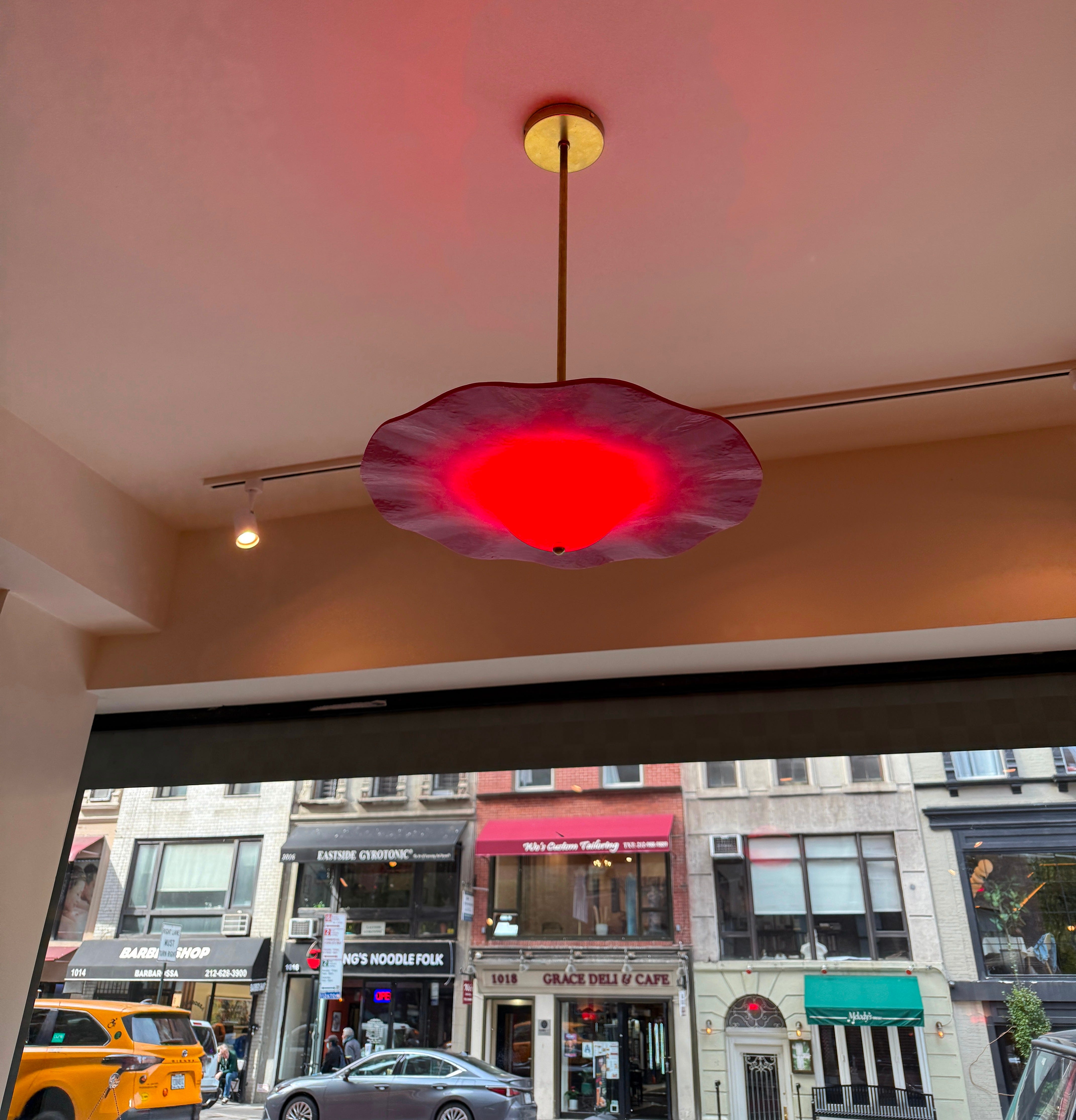
I first became aware of Anna Dawson’s work when I visited the Upper East Side outpost of Big Night. Hanging above a dining table was this glowing red orb, almost alien-like in presence. Katherine Lewin, Big Night’s owner, was in the shop that day and she told me who made the light — Anna Dawson.
After that, Anna’s work started showing up on my feed and I was absolutely entranced by it. It’s only so often that you find design that really makes you feel something. Absolute wonder. (I need to come up with a word for that phenomenon — perhaps the Germans already have one.)
Anyhow, I had to know more about Anna and I’m so pleased that she agreed to a Q&A. Read on to hear about her transition from photographer to designer, the memorable themes she focuses on, the financial structures behind licensing deals, and her badass ribbon-dancing grandma.
She’s just launched a new collection today on her website! Otherwise, you can also find her wares on Lightology and Claude Home. (FYI, Claude carries exclusive colors of Anna’s designs, and I NEEEED the blue sconces. Also Maggie Holladay of Claude has a great Substack.)
Schmatta: I’d love to know more about you — who you are, where you come from.
Anna: I’m from the San Francisco Bay Area originally. Both my parents are architects, so there’s a lot of design in my family — my brother’s a shoe designer, and I’m a furniture designer.
I lived in Seattle for a while, where I was a working artist and photographer. At the time I was working for a friend who had a furniture company and was manufacturing all his own work, so I’d go in and help him sand things. That’s when I became really interested in design and thought maybe I’d go to design school — I ended up at the Rhode Island School of Design in the Furniture Department.
Leonora: How do you go from being a photographer to getting into a furniture program? What do you present for your portfolio?
Anna: The photography I was doing was really sculptural — I had a show where I made lights out of photographs, so “photographer” is a loose term. I used that work and other photography I’d done for my portfolio, but RISD isn’t really looking for people with furniture backgrounds. They like to bring in people with really different backgrounds and perspectives. A lot of people go the art route there, but coming from being an artist, I didn’t want to be an artist — I liked thinking about production, problem-solving through making, learning a process and then figuring out how to innovate on it or find space for something new.
<Anna’s design for Heller: Swell Wall Catchall, $100>
Leonora: So your “breakthrough” was the Heller wall hook?
Anna: In the middle of school I presented a wall piece I’d designed at ICFF with RISD. Heller saw my piece and was interested in licensing and producing it. People always ask what the strategy was — honestly, there wasn’t one. It sort of happened to me.
Leonora: I’m always curious about the financial side of licensing deals — how does that actually work?
Anna: I don’t want to share specific numbers, but it wasn’t a lot of money — though it did pay for studio space, which was really helpful. Now that I run my own business, I understand it better: [companies like Heller] front a lot of risk and money. The wall hook is an injection-molded plastic piece now, so developing a mold alone can cost up to six figures. It was never a product I was going to put into production myself, and I wasn’t interested in trying.
Leonora: Is it structured like a book deal — an advance plus royalties?
Anna: There’s no advance, just a royalty. The nice thing about licensing, in the right circumstances, is that it can be passive income and passive work — you get to act more like a creative director rather than someone hands-on in development. But for all my lighting work, I do all of it myself.
Leonora: Your lighting has had so much buzz…you must be doing well!
Anna: Actually, I’ve had a day job this whole time [*Anna was a furniture designer for another brand] — yesterday was actually my last day, so today is my first day working for myself full time!
Leonora: Why do you think your lighting is breaking through right now?
Anna: I’m not totally sure, but the pieces that are most popular are my sconces — maybe it’s a combination of price point and material; glass is really hot right now. Those pieces came out of a lot of experimentation.
Leonora: What was the inspiration behind the Dawn surface mounts?
Anna: It was inspired by how the sun draws across the horizon — specifically over the ocean. I thought about growing up in California and going to the beach; I thought about that shape a lot.
Leonora: And the Horizon lamp?
Anna: Similar, but thinking about the reflection of the sun on water — you get a distinct shape and then an abstracted, elongated shape depending on the day and wind.
Leonora: Any other pieces with a good backstory?
Anna: I love the Calle sconces. Everyone says they look like flowers, and they are floral-inspired, but they’re really named after the little paths (“calle” — Spanish for a kind of path) leading to the beach where I grew up, which are lined with calla lilies at certain times of year. I wanted to capture that exploratory feeling of walking through the path and then emerging at the beach.
Leonora: What are you working on next?
Anna: I’ve just launched a collection inspired by dance. I’ve been thinking a lot about ribbon dancing, which my grandmother used to do — she was from Taiwan, worked for the government, and traveled the world doing dance exhibitions as a form of cultural exchange. As a kid, she’d come teach ribbon dancing at my school — everyone would tape ribbon to chopsticks and run around with it. She also did a form of northern Chinese “mountain dancing” with bamboo sticks. I love the movement of ribbons — how light they feel, and how gravity pulls at them so elegantly.
(Above and below: Anna’s grandmother, badass ribbon dancer.)
From that, I have the Dancer sconce, which is similar in process to the Calle sconces but with a “waist” — there’s a symmetrical version and a more dynamic asymmetrical version.
There’s also the Ribbon chandelier, my first chandelier, which tries to capture that gravity-and-ribbon feeling, and the Twirl table lamps, which take a form similar to the Horizon lamps — all glass, base included, illuminating as a whole piece. The Twirl lamps were inspired by the way a skirt fans out when you twirl.
The end! Be sure to follow Anna on Instagram @studioannadawson.


